Classical Christian Education through The Great Books
When we think about Classical Christian Education we’re speaking to the best and highest educational form as yet devised by human art. There have been many methods of education that have had moderate success but the Classical Christian Method has this over all of the others: First, it is accommodated to the human being as they actually are, created in the image and likeness of God and designed by Him to fulfill certain purposes. Second, it is within the framework of the world as it actually is, has been and will be. And third, it is the best practical preparative for life and well being in the world as it is.
We see that every method for education has a few things we can call presuppositions. Presuppositions are the often unstated ideas that lie behind the things we say or do that determine the meaning of those things in our own minds.
Those presuppositions will be what they think the world is, how they think the world works and what they think education is supposed to do. For example, if they think that human beings are just accidental animals that have no objective value or purpose, that there is not a way that the world actually “works”, and that neither the person nor the world have any intrinsic meaning there will inevitably be an outcome of all that.
That outcome will not be a good one.
And how could it be? Because an outcome being good or bad is rooted in it having some intrinsic meaning or purpose of which it can be weighed as “good” or “bad”. So in Christian education we put our cards on the table: we think education is either good or bad and that we are trying to educate good students to live good lives. It is not a value free education and it is not morally neutral. We are trying to produce a certain kind of student, not for the industrial market or service to the state, but for God and their neighbor.
So smart? Yes, of course but anyone can produce smart.
Efficient? There is nothing inherently wrong with efficiency but to what end?
Capable of getting a job? If a child is educated in being a good person of wisdom and character they will never have a hard time finding a job. They will be leaders, creators, visionaries, organizers, artists, ministers, teachers, officers, soldiers, governors and kings. A full and rich education prepares a child not for this or that thing – but for everything.
So the learner must learn how to learn. There are ways that the great thinkers and civilizations have produced strong and healthy souls for thousands of years. I would not like to say that we do things this way because they “work” (this is not reducible to mere pragmatism) but to ignore a path that has worked for centuries and achieved incredible victories is unwise. We learn from those that came before us because in them we see the future.
So here will be books, big, fat beautiful books, because books will fill the child’s mind with intelligence, wisdom, morality, duty, consideration and consideration. Books are their ancestors speaking to them from 1000 years hence to say to them, “this is the path of wisdom”. A book is the means God chose to communicate his truth and books are the way the wisest people that ever lived left their legacy in paper and ink.
The Bible (Old and New Testaments): If I assign that your student read the Bible in the King James Version it will be an anachronism, strange, hard and make them work much harder than any child should need. It will also make them strong, wise, capable, unflappable, able to navigate difficult texts and learn the English language better than any of their contemporaries. They learn what people are, why they matter and what they are trying to do. They learn virtue and vice, rules and consequences, wisdom and foolishness. I’m not dismissing the NIV or the ESV, I’m just saying that they are not sufficient for the serious matter of life-training your little person.

Homer (The Iliad and The Odyssey): The twin epics of ancient Greece that established the ideals, values, and “meaning” traditions of the Western world.
Virgil (The Aeneid): Rome’s national epic bridging Greek mythology with Roman virtue and personal destiny.
Plato (The Republic): The primary Western Philosophical and political text..
Aristotle (Nicomachean Ethics / Politics and the Metaphysics): The foundational text for understanding the world and the things that exist.

Augustine (Confessions and The City of God): How did all of those readers of the great pagans like Homer and Virgil become Christians? Augustine, the greatest evangelist in the history of the world outside of the Bible itself. These masterworks merge classical Greco-Roman philosophy with Christian theology creating Western psychology and the Western Civilizational context.
Thomas Aquinas (The Summa Theologia): A principle contribution to understanding things, their relationships and why we see the world the way we do, from reason and nature.
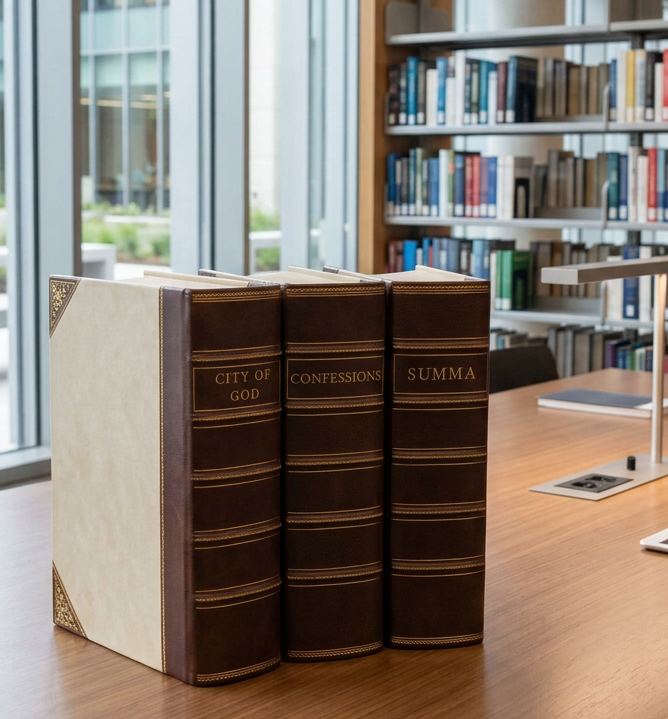
Then upon that basis of informed understanding:
Dante
Chaucer
Luther
Calvin
Milton
Shakespeare
The Westminster Standards
Introduction and Overview of Modern Philosophy and the Contemporary World
Why these? This is what has always been done. Why has it always been done? Because we can’t interpret the world in which we live – nor revise the entire human experience, before we know what it has been until now. We might get to the place where we can sit in judgment over the classics and the history of the world – but not until we know what it was.
Rev. Christopher Scott Neiswonger JD MA
Principal, Homeschool Southaven Education
Contact Deni: a1000Generations@gmail.com

